SOM Online Magazine for Winter here.
NHS Employers have a selection of resources on their website in relation to the menopause. Here are some links:
Information on how menopause can affect people at work and practical guidance for employers on how to improve workplace environments for them.
Improve the way you address menopause and work. The NHS Staff Council’s Health, Safety and Wellbeing Group developed this guidance to support NHS organisations to improve the way they address menopause and work. This is complemented by principles for line managers and staff.
Menopause and the workplace webinar
A webinar which focused on how to support colleagues with menopause in the workplace.
Improving menopause support for staff: Sherwood Forest Hospital Foundation Trust
Case study on how Sherwood Forest Hospital Foundation improved its support for staff going through menopause.
NHS staff wellbeing needs poster
This resource highlights the importance of basic needs to help ensure our NHS people feel healthy at work.
Health and Wellbeing at work is back for a successful 17th year at NEC, Birmingham on 14-15 March 2023.
It’s the UK’s largest event dedicated to improving the health, safety, wellbeing, behaviour and culture of today’s workforce.
The 2023 conference programme includes speaker sessions from key stakeholder within the industry including Council for Work and Health Honorary President, Professor Diana Kloss who will discuss The Duty of Care and Legal Liability of the Occupational Health Professional. And Council for Work and Health Deputy chair, Dr Robin Cordell, discusses Leading Assurance and Enhancing Value in Occupational Health Service Provision.
To view the full event programme and list of speakers visit www.healthwellbeingwork.co.uk and to register visit https://eventdata.uk/Forms/Form.aspx?FormRef=HWW33Visitor
The recording of the seminar Evaluating interventions in work-related ill health is available to view here:
(4 November 2022)
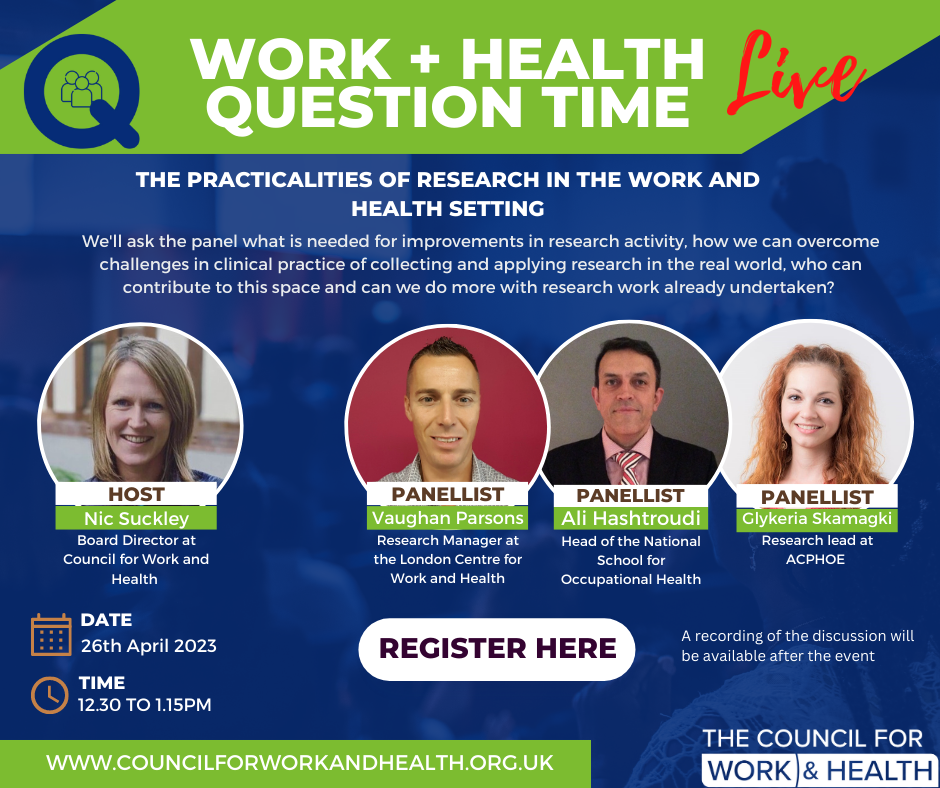
We held our first Question Time panel session on 2 November 2022. The panelists were:
Kathy Roberts, ACPOHE
Sarah Holt, RCOT
David Long, Department for Work and Pensions
The session was Chaired by CWH Board Director, Nic Suckley, with support from Mandy Murphy.
David Long introduced the subject by giving an overview of the changes introduced, the reasons for them and the governments vision for their future purpose. After their introductions the panel responded to the following questions
Below is the YouTube recording of the event:
Additional links that may be helpful are:
Fit note – GOV.UK (www.gov.uk)
The Fit Note – elearning for healthcare (e-lfh.org.uk)
Health and Work Resources/FREE
https://acpohelms.co.uk/login.php
Click on free guest access
BOHS Response to All-Party Parliamentary Group on Respiratory Health Call for Evidence to Update Report:
Silica: the Next Asbestos?
Risk reduction in the context of occupational exposure to?? respirable crystalline silica pdf
SOM have prepared a paper on Long Covid and Return to Work – what works.
https://www.som.org.uk/sites/som.org.uk/files/Long_COVID_and_Return_to_Work_What_Works.pdf
From 1st July 2022, fit notes can now be certified and issued by registered nurses, occupational therapists, pharmacists and physiotherapists, in addition to doctors. In the Government guidance for employers[1], the Department for Work and Pensions (DWP) makes clear that not all individuals within these professions will be suitably experienced and qualified to certify and issue fit notes, so will only do so where they have the relevant training and knowledge to make an assessment of a person’s fitness to work.
The organisations that form the Council for Work and Health include doctors, nurses, occupational therapists and physiotherapists, and other professionals with training and knowledge who can advise on health and work, and who can also advise on training for those now providing fit notes.
Unless they themselves are working in the NHS, doctors, nurses, occupational therapists and physiotherapists working in occupational health will not usually have access to paper or digital versions of the ‘Med3’, which is the form these health professions working in NHS primary care will use, or the F Med 10, which these professionals working in NHS hospitals may now use. Other forms of medical evidence, including private medical certificates, occupational health reports and an Allied Healthcare Professionals Advisory Fitness for Work Report can be accepted as medical evidence in the same way as a fit note, subject to the employer’s agreement. DWP go on to advise that in this instance the employer does not need to ask their employee to obtain further fit notes from their GP.
Other aspects of the guidance have not changed, but the following are areas in this guidance where over recent years we have come across some misunderstanding:
[1] Guidance for employers on the fit note (updated 1 Jul 2022) at: https://www.gov.uk/government/publications/fit-note-guidance-for-employers-and-line-managers
[2] Government guidance on the further support provided by occupational health services at: https://www.gov.uk/government/publications/fit-note-guidance-for-employers-and-line-managers/getting-the-most-out-of-the-fit-note-guidance-for-employers-and-line-managers#further-support
As a veteran of the health and wellness industry, it is hugely gratifying to finally witness first-hand the sea change in attitude occurring when it comes to employee health. Employers now realise that it makes sense to heavily invest in the maintenance and growth of their most important asset, their people.
Dr Mike Goldsmith Life President and Founder, Medigold Health