BOHS latest press release: BOHS responds to the latest HSE statistics calling for a “Sustainable Workplace Health Strategies”
Monthly Archives: November 2020
IOSH: Decade of action for occupational safety and health
As the ‘Decade of Action’ (2020-30) for the United Nations Sustainable Development Goals (SDGs) grows in urgency, what should it mean for occupational safety and health (OSH) and ensuring that allwork is good work? How do we best address the needs of a virus-affected world and the challenges and opportunities of the 4thIndustrial Revolution, the digital and green economies, demographic and technological changes, and the future of work? How do we ensure that we revitalise our support systems and ‘build back better and healthier’?
Many of the SDGs relate to work and to OSH, as highlighted in the IOSH sustainability policy, particularly SDG Goal 3 ‘Ensure healthy lives and promote wellbeing for all at all ages’ and SDG Goal 8 ‘Promote sustained, inclusive and sustainable economic growth, full and productive employment and decent work for all’, which includes ending modern slaveryand human trafficking.
Importantly, as we’ve all witnessed, the Coronavirus pandemic has reinforced the intrinsic links between environmental, public, occupational and general health, as well as shining a light on health inequalities and the need to better protect health and social care workers and others on the frontline, and to ‘build back better and healthier’. This includes ensuring effective test, trace and isolate systems, and access to personal protective equipment, vaccines, therapeutics and ongoing mental health support. Central to delivering improvement is SDG Goal 17 ‘Strengthen the means of implementation and revitalise the global partnership for sustainable development’. This UN call for international capacity-building and multi-stakeholder partnerships to ‘mobilise and share knowledge’ is a clear request for stronger multidisciplinary working and for all health and health-related professionals to contribute.
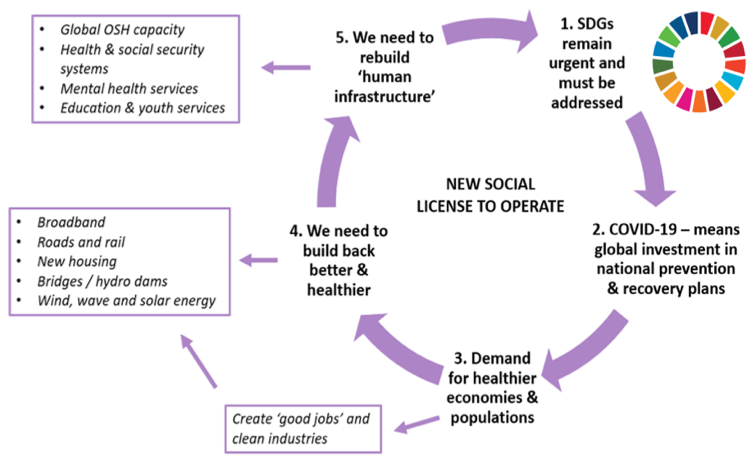
This is where I believe the collective health community, professional bodies and networks have pivotal roles, both now and in the future. We need to see OSH / OH professionals increasingly harnessed to help public policymakersand organisations tackle the complex work-related health challenges, such as from climate change, air pollution and extreme weather; increased sedentarianism; extended working lives; the needs of workers with health conditions and disabilities; tackling communicable and non-communicable diseases at work; and the exponential growth in new workplace technology, automation and artificial intelligence.
We need to work together to ensure greater focus on human-centred public- and corporate-policy and on managing psychosocial risk at work, with mental healthfinally gaining parity with physical health, and stigma ended. And we need to collaborate to support diverse and inclusive workforces, protect vulnerable groups and embed OSH risk-intelligence as a key life- and employment-skill, essential to long-term social value and achieving SDG Goal 4 ‘Ensure inclusive and equitable quality education and promote lifelong learning opportunities for all’.
Thankfully, in the decade ahead, I think we can expect to see better-informed public opinion continue to drive higher societal expectationsand requirements on organisations and leaders seeking new ‘social licenses’ to operate and govern. And also see improved performance evaluation and transparency increasingly sought by stakeholders wanting assurance, not only that no-one is being harmed by public policy or corporate activity, but that people’s health and wellbeing is actively enhanced in line with our more socially conscious world.
This demand for transparency and comprehensive corporate reportingwill help drive meaningful and comparable OSH performance reportingat global, national and corporate levels and recognition that good OSH must be a fundamental right worldwide. Professionals have key parts to play, fostering positive and learning cultures; designing-in OSHand evaluating interventions; developing meaningful indicators and utilising data; and making recommendations to improve OSH performance across regions, organisations and supply chains.
So, what key changes are needed to tackle the millions of work-related deaths each year, improve OSH and wellbeing and deliver on the SDGs? I believe they must include:
- Recognising OSH as essential to public and socioeconomic good, so that it is designed into all public-policy,global trade, international development and corporate strategies
- Building global OSH capacityand improving access worldwide, including for micros, SMEs, the self-employed, migrant and informal workers and all those on the frontline
- Harmonising and standardising meaningful OSH performance reportingto drive global, national and corporate decision-making and investment for prevention, emergency planning and improved OSH and wellbeing
To close, can I just urge that, as professionals, influencers and networks, we continue working together and reaching out to ensure that this decade is one in which the true value of OSH / OH is harnessed to support good work for all, healthier populations and sustainable futures.
If you’d like to know more and support IOSH’s advocacy work on ‘building back better and healthier’, please contact the IOSH Policy team at publicaffairs@iosh.com.
Richard Jones
IOSH
13 November 2020
Leadership in occupational health over the first wave
Leadership in occupational health over the first wave
As the pandemic hit, time seemed to alter, and intensity increased. The pace of “leadership responsiveness” required multiplied. Suddenly, we needed to be “just in time” rather than the days or weeks that medical societies usually take.
The office team “disappeared” in March to work (very effectively) at home. A new, wider, team emerged beyond the Society of Occupational Medicine, of professionals from different disciplines and organisations. Subgroups focused on PPE and mental health at work were formed. New communication channels opened with daily briefs, weekly webinars, and front-line networks.
Expert leadership was important. Occupational Medicine experts quickly called out the Government’s position on PPE standards and supply. But we knew little about Covid, for example in terms of transmission mechanisms. We quickly hosted a webinar with an Italian occupational medicine expert, ahead of the UK in terms of Covid impact, as to what they were experiencing in hospitals.
It was inspiring to see leadership elsewhere. As Covid-19 deaths tragically increased, a former Windsor Leadership Trust Alumni, and a former President of the SOM, David McLoughlin kept me in touch as to the military’s amazing work setting up the Nightingale Hospitals. Many occupational health professionals working in the private sector volunteered to work in the NHS. NHS England put in place procurement to support NHS occupational health teams.
In April, we decided to move to proactive challenge and focus on the occupational health risk of health care professionals. Dr Will Ponsonby, the SOM President, publicly rejected the Government’s rhetoric of professionals on a front line “war”. Instead we campaigned with the BMA and others “that no health care worker should die of Covid transmission” if proper controls are in place. Amnesty International subsequently produced a report highlighting this issue[i].
In the middle of this, a refreshing culture emerged ofleadership that was still about rationality, objective truth and weighing up the evidence but also about warmth, collaboration and energy (although energy was hard to maintain when it was all online).
With the end of the initial lock down in sight, we focused on the risk of return to work. A collaborative, leadership style continued with new partnerships emerging. We achieved in weeks what would previously have taken months with organizations such as Mind, CIPD, BITC and Acas to offer advice and toolkits. And, even with the frenetic pace of activity, we found out a bit more about each other and our solaces (in my case re watching a lengthy BBC Programme about a shepherd taking Herdwick sheep off a hill).
Despite our new confidence of working with trusted partners, with the launch of effective new advice and “toolkits”, we struggled to influence. Government was in an emergency “command / control mode”. Responses from the “Centre” on key issues were delayed or not forthcoming. It felt a bit Vicky Pollard … “yeah but no but yeah”.
Some things we did not get right. I regret not reacting to data that emerged showing that some occupational health groups such as minicab drivers and security guards were more at risk of dying from Covid. We must highlight the inequality that Covid is creating and avoid a “white collar” prejudice at the expense of those working in low income public facing roles or factories such as in meat packing who have a higher Covid risk.
In July we launched a new report on the mental health of nurse and midwives, but like many by the end of July, I needed a break. Zoom calls blurred into one and it was hard differentiating online with real life. I needed to practice what I preach in our “mental health in the workplace toolkit” and take a break.
In September, we started again with the confidence that we have a social purpose to make a difference to workplaces. We were profiled in New Scientist magazine. However, pressures quickly started again though in terms of questions on testing and how any vaccine would be delivered.
Questions remain. In terms of risk, one risk of Covid transmission can be reduced in place of another in terms of the health risks of unemployment. We are hosting, with partners, a summit on this on 10thNovember (at https://www.som.org.uk/civicrm/event/info%3Fid%3D313%26reset%3D1)
It is important to celebrate success (with an awards process for innovators who have come up with tools such as the “Covid Age” next month). We need to support current and future leaders through mentoring and peer support. We should be offering leadership training to those occupational health individuals who have the potential to become our leaders of the future. We are actively looking for funding for this.
We now need to pace ourselves for the winter…
[i]https://www.amnesty.org.uk/press-releases/uk-among-highest-covid-19-health-worker-deaths-world
Nick Pahl